Showing posts with label Gettin' Paid. Show all posts

Monday, 3 October 2016

Deutsche Bank: A Vertically Integrated Problem

Recent concerns about Deutsche Bank’s financial position highlight again that banking remains fragile. On Friday Deutsche Bank’s shares fell nearly 9% at the opening bell as investors panicked about news that hedge funds had started to pull business from the company.  This comes off the back of increased concerns about potential writedowns and the vulnerability of its coco bonds at the start of the year.

The immediate trigger for this most recent panic is a $14bn demand by the US Department of Justice to settle allegations related to the mis-selling of mortgage backed securities & CDOs during the 2000s boom. This comes after several other large banks settled similar cases with the DoJ: Bank of America paying a $16.65bn settlement for activities undertaken by it and its subsidiaries including Merril Lynch and Countrywide Financial Corporation, JP Morgan paying $13bn and Citigroup  $7bn. In some cases the fines eventually paid were significantly less than the original sum demanded by the DoJ. There is hope within Deutsche Bank that a similar deal can be struck and a lower amount paid, with recent estimates venturing that the figure could be closer to $3-4bn.

But Deutsche Bank’s bargaining position with the DoJ may be hampered by the specific detail of its activity in RMBS and CDO markets during the boom. Unlike US banks, Deutsche Bank ran a more vertically integrated model of securitization (Exhibit 1) which meant it occupied a different space in the market compared to its competitors. By integrating trustee, listing and other administration functions (which are provided by external parties in most US CDOs) the DoJ will have to consider whether Deutsche Bank’s larger footprint potentially gave it a knowledge advantage.

Exhibit 1: Deutsche Bank entities co-participation in CDOs. Line thickness = #of joint products (values given); size of node = #of CDOs involved with.


To illustrate the point, with the STAtic CDOs that featured heavily in the Senate report on the causes of the financial crisis (373 f. Footnote 1505), either three or four Deutsche Bank entities were usually involved in their structuration: DB’s Irish Deutsche International Corporate Services Ltd., its Cayman Deutsche Bank (Cayman) Ltd., its American Deutsche Bank Securities Inc., Its Luxembourgian Deutsche Bank Luxembourg S.A. and Deutsche Bank (Exhibit 2). These positions were mainly occupied by independent providers in the case of US bank CDOs. Not only that, but Deutsche Bank also sold these services to other market participants (Exhibit 3).

Exhibit 2: Deutsche Bank entities involved in START CDOs 


Exhibit 3: Comparison between Deutsche Bank entities and other major US banks involved in the CDO market


The DoJ will have to consider whether Deutsche Bank’s vertically integrated model gave it access to more information about the quality of the due diligence and thus the underlying collateral in the CDO market. If it believes Deutsche Bank’s structural position meant its employees did know more than their competitors, then - given the febrile context - it might now be financially prudent to consider jail time for the individuals involved rather than fines for the institution. 

Stanley & Tatu.


Thursday, 5 December 2013

Boris Johnson: Cheer Leading For Inequality

When he gave the annual Margaret Thatcher lecture Boris Johnson’s praised inequality in a calculated way. He was positioning to challenge the Tory leadership from the right, if and when Cameron and Osborne fail to increase Tory seats at the next election.

Perhaps in an attempt to block Johnson’s manoeuvring, George Osborne, in a softer way, repeated those sentiments in his comment on Johnson’s lecture: inequalities of outcome are inevitable; the important thing is to ensure equality of opportunity through schooling:

"I think there is actually increasingly common agreement across the political spectrum you can't achieve equality of outcome, but you should be able to achieve equality of opportunity… You should give everyone, wherever they come from, the best chance, and, actually, education is the key to this."
This is partly wishful thinking when schooling in so many ways reinforces inequalities driven by catchment areas and the residential segregation of different income groups. But the more troubling point is that the Tory Right are now trying to break with the Westminster consensus in several ways.

First, the five Tory back benchers who wrote Britannia Unchained have blamed our lazy workers for continuing underperformance: “The British are among the worst idlers in the world. We work among the lowest hours, we retire early and our productivity is poor. Whereas Indian children aspire to be doctors or businessmen, the British are more interested in football and pop music”.

Now Boris Johnson praises the deserving rich who are smarter so that they will inevitably succeed against the masses who, on his account, have low IQs not a deficient work ethic. Johnson presents us with the cornflakes pack account of social reproduction and income inequality:

“Whatever you may think of the value of IQ tests, it is surely relevant to a conversation about equality that as many as 16 per cent of our species have an IQ below 85, while about 2per cent have an IQ above 130. The harder you shake the pack, the easier it will be for some cornflakes to get to the top”

This analogy rests on a farrago of unjustified assertion about competitive struggle, half-truth about the contribution of the rich and sleight of hand about the IQ evidence topped off by a failure to distinguish between income and wealth inequalities.

1. Johnson’s whole argument is framed  in a familiar way by the assertion that our country and individuals within it are all engaged in ceaseless, striving competition:

  “Like it or not, the free market economy is the only show in town. Britain is competing in an increasingly impatient and globalised economy, in which the completion is getting ever stiffer. No one can ignore the harshness of that competition, or the inequality it inevitably accentuates; and I am afraid that violent centrifuge is operating on human beings who are already very far from equal in raw ability, if not spiritual worth.”

This is really a quite peculiar perception which hardly fits the facts. The balance between internationally exposed and sheltered activities in Britain has been decisively changed by the competitive failure of British tradeable goods. Real manufacturing output has not increased in the past forty years and manufacturing now accounts for no more than 11% of GDP; our export success is narrowly concentrated in financial services from London finance whose activity brings public risks as well as private rewards.

Johnson’s argument completely ignores the sheltered “foundational economy” of private and public organisations producing everyday goods and services. Pipe and cable utilities, transport infrastructure, food processing, supermarkets, health, education and welfare altogether now employ 40% or more of the workforce. In these sectors, pay relativities and minimum wages are not determined by competition from Guangdong Province but are a result of social choices intersecting with business models

2. Johnson tries to legitimise income inequality by making disputable claims about how “the rich” contribute to society through paying taxes.

“ When Margaret Thatcher came to power in 1979 they ( the rich) faced a top marginal rate of 98% and the top 1% of earners contributed 11% of the government’s total revenues from income tax. Today, when taxes have been cut substantially, the top 1% contributes almost 30% of income tax, and indeed the top 0.1%- just 29,000 people- contribute fully 14% of all taxation. That is an awful lot of schools and roads and hospitals paid for by the super rich”

We‘re fairly sure the 30% figure exaggerates the contribution of the rich. A quick google  search highlights a BBC story from 2009 which suggests that the figure is below a quarter for the top 1%. The 30% figure does not come from any kind of academic source since but seems to have been put into circulation by a stockbroking firm Oriel Securities which explicitly says it is doing “non independent research which constitutes marketing communications “

And the 30% of taxes claim represents the same sleight of hand as in the old trade narrative about London finance’s contribution which we dissected in our Alternative Banking Report of 2009. London finance highlighted its 30% contribution to corporation tax and ignored the fact that its contribution to all taxes paid was half as large and a sector like manufacturing paid more. So it is in this case where Boris Johnson highlights share of income tax without discussing the broader picture. Mrs Thatcher did not reduce state expenditure’s share of GDP, but cut income tax rates and shifted the burden of taxation onto regressive consumption taxes. So the share of all taxes paid by the rich is much lower than 30% and it is the poor and middle income groups who are paying for their own schools and hospitals

3. Johnson’s category of “ the rich” conflates inequality of income and wealth; if we dis-aggregate the two groups, the relation between IQ and income is positive but the relation between IQ and wealth is almost certainly non existent


Here is a standard sociologist’s take on the correlation between IQ, income and wealth. 
There is a loosely positive correlation between IQ and income, but it is not immensely strong. That is because, for example, there are many examples of institutions which pay modest wages to high IQ individuals – public universities being one good example. But the more interesting finding is that the correlation between IQ and wealth is completely absent. And the obvious explanation for that is because wealth is inherited without conditions as to intelligence, diligence or anything else.

Inherited wealth is the big problem for the new social Darwinists like BoJo. Not least because the past 30 years of widening income inequality will be followed by congealed wealth inequalities because the rich cannot easily be prevented from having children who will often be dim scions. These inevitabilities would be best addressed by a system of death duties and inheritance tax which (unlike the present regime) could not easily be dodged by setting up a family trust.

The fundamental problem is always the economic and social reproduction of inequality. But that is always invisible in Johnson’s discourse.

Dyfal Donc and Stanley

Wednesday, 8 May 2013

The English Premier League: Unintended Consequences


The world often follows the law of unintended consequences. Institutions are formed, laws are passed and processes implemented to remedy some pressing problem, only to find some new, wretched misfortune come crawling from its structures. We can see this in finance, where the well-intentioned risk-weighted capital adequacy ratios of Basel II encouraged banks to create ever more elaborate synthetic securitisations which ended in global financial catastrophe. We can even see it in my profession – academia – where Thatcher’s Research Assessment Exercise (RAE) (now the Research Excellence Framework ‘REF’), was expected to rectify a perceived lack of quality and productivity in the research output of the university sector. The result – arguably – is a homogenisation of output and soar-away wages at the top as academics willing to play a mercenary REF game pit employers off against each other, with uncertain outcomes for the collegiality and cost control that have traditionally held those institutions together. Paraphrasing Chris Dillow, Thatcher’s vision was of a diligent and creative University sector exercising moral restraint: she wanted universities staffed with people like her father. She got universities with people acting like her son.

But the topic of this blog is not finance or academia, it is football. And football represents another good example of unintended consequences. In 1991 when the big 5 clubs (then - Manchester United, Liverpool, Arsenal, Tottenham Hotspur and Everton) were approached by Graham Kelly of the Football Association (FA) to form a breakaway league, it was done on the promise that fewer games would lead to higher quality football, which in turn would encourage new money from TV and sponsors. It was anticipated that this would stabilise the financial position of clubs within the league, allowing them to invest in new facilities and improve the experience of matchday fans (Guardian 8th April 1991; The Times 9th April 1991). Support for the new league also took place against the backdrop of the Taylor Report which required clubs to convert to all seater stadiums. It also reflected the FA’s paranoia about the parlous state of the English national team, and the prospective loss of English talent to the Italian league (Independent 9th April 1991). The rest is history. The deal was done very quickly with the FA and the elite clubs effectively winning a power struggle with the Football League. Murdoch spied the opportunity to cement his new subscription television channel – and the Premier League was born.

It is interesting now to look back on those promises and see how much has changed. Certainly the prophesied income streams did materialise. Television and commercial sources of income as a percentage of total income have increased. Similarly average attendances did grow, from around 21,000 in 1992 to a peak of around 36,000 by 2007/8 – although some of that growth is down to an averaging effect in a smaller league. But contrary to expectations the new income did not improve the economic stability of those clubs. In fact, arguably the opposite has happened. If we were to track the total operating loss of the top two leagues after player trading and interest, but before tax this is a sector whose fundamental operating characteristics have degenerated over time.  According to Deloitte, by 2010/11 the aggregate pre-tax loss of the teams playing in the Premier and Championship combined was £569m. Similarly, although facilities for fans have undoubtedly improved, that has come at the price of escalating matchday prices, squeezing out lower-waged core, local support.

Source: Deloitte (2012) Annual Review of Football Finance


So how did this come to pass? To answer that question we need to think about the financial characteristics of the game and the governance mechanisms within which the industry is embedded.

One of the central puzzles of the football industry is why so many people seem willing to buy into an industry with secular profitability problems? Of course there are squillionaires like Roman Abramovich and Sheikh Mansour Bin Zayed Al Nahyan for whom the club is a status symbol and whose multi-million pound investments are the equivalent of the annual depreciation on our motor cars. But there are many other owners for whom the relatively predictable cashflow from the game has some appeal, even though margins are generally low or negative. Cashflow is important because it gives prospective owners the option to purchase a club with debt, giving them control with reduced personal financial commitment and exposure. Measuring the size of those debts is tricky because it often sits in one or more of the holding companies used to buy out the club, which can descend onto the operating entity to disastrous effect. The Guardian puts the net debt figure for the Premier League at £2,408.5m on losses of £205m; where interest payments account for £100m of that £205m loss. Deloitte estimates that net debt in the Championship was £720m on a loss before tax of £189m. There is some evidence that in the last 2 years debt has fallen in some cases, but the general characteristics of a levered, negative margin business remains.

But not all of the losses are due to interest payments, so are there other reasons why football clubs are so attractive to investors? When only 7 of the 20 Premier League clubs and 10 of the 24 Championship clubs are wholly owned by UK nationals, that’s an important question. Positively, they offer cachet to the buyer on an international stage and may provide an option on jackpot returns in the future. That is a very real option because each successive television deal offers lucrative revenue growth that will be capitalised in the future value of the club. Similarly a championship club reflects a solid build and sell opportunity, particularly if they can get promoted and established in the Premier League. That may partly explain why losses are tolerated in the short term. But there are other less palatable attractions. The cashflows are eminently clippable and the assets eminently strippable, so that even if the club posts losses, individuals at the apex of the club can skim cash through emoluments and other payments, dividends, commissions for interested parties, iffy sale and leaseback deals, interest payments to financing holding companies and a myriad of other mechanisms designed to get more juice out of the lemon. This is possible because the industry is notoriously opaque and riddled with complex corporate structures that inevitably reach out into the tax havens of the Caymans, Guernsey and elsewhere. This leaves the door open for all kinds of unseemly behaviour.

This last point is a central theme of CRESC's recent research: the relation between elites and the firms in which they carry out their business. In football those elites are not just owners, but also players, managers and their representatives who all place claims upon the club. The general argument that I and my colleagues make is that the growing internationalisation of revenue flows has created value skimming opportunities for well placed individuals. In football, the absence of any control mechanism – either on the corporate governance side through fan ownership or on the regulatory side through a wage cap - means that those well-placed individuals weaken the club’s financial position. Paradoxically, however, the game has become more reliant on those individuals: the network connections, particularly between clubs, managers and agents, now critically determine the access to talent which may improve on-pitch success. Those interpersonal network connections are thus both a source of revenue creation or capture and a means of securing the success demanded by fans; but they are also a source of fragility because those same networked individuals come at a price - they are, in other words, extractive too.

The outcomes of all this are very uncertain. It raises all kinds of confusion about alliances and allegiances from the fans’ perspective: who to identify with, and who or what is the problem? There is a noticeable shift in the discourse from elements of the support base, from a concern with the club as a social institution, to an increasing identification with the corporate concerns of the elites within the club. But the traffic has not all been one way. Equally there is growing resistance to the commercial representations and activities of the club – perhaps most dramatically illustrated in the takeovers of Manchester United and Liverpool, where the owners’ use of the term ‘franchise’ became an emblem against which many supporters groups mobilised. Nevertheless we see a second fragility emerging beyond the financial characteristics described above: there is an equal withering of the club as a social institution. And this fragility is in part a product of the growing influence of elite networks around the game.

New money should have stabilised clubs, but it has not. Clubs as both cultural entities and economic institutions have become more fragile and wrought with tensions as new elite networks become central to the capture and extraction of revenues in the sector. The FA’s approach to ownership is in keeping with a form of capitalism peculiar to the British, where everything is for sale provided the purchase price is right. But the game in its current form is not sustainable. Clubs as financial entities cannot continue without regular loans or other cash injections. There needs to be a countervailing force which keeps value skimming and extraction by these networks in check. Greater fan representation on the board might just provide the long-view needed to do just that.

Mr Pro-Celebrity 5-Aside


NB: A CRESC Workshop on these and other themes will take place on Friday 17th May 2013, details below:

CRESC Workshop: Football, Fans and Finance

Friday 17th May, 10am – 4pm
University of Manchester

Kanaris Lecture Theatre, Manchester Museum, Oxford Road, Manchester

Workshop Panel:
Andy Burnham (MP), Andy Green (Andersred blog), Jim White (Telegraph)

Other Workshop Presenters: 
Adam Brown (MMU and FC United of Manchester Board member), 
Christine Cooper (University of Strathclyde), 
John Hughson (UCLAN)
Pete Millward (Liverpool John Moores).

Cost and registration details: £20 (includes refreshments and lunch); £10 concessions.
Limited spaces: to book your place please contact: heather.whitaker@manchester.ac.uk


Tuesday, 30 October 2012

So, define 'talent'...


Ask anyone within the apologencia of the financial services industry why bankers are paid so much and the stock answer you will receive is that in a knowledge-based world, talent is the key source of competitive advantage; and so banks pay the market rate to retain talent and remain competitive. But with banks across North America and Europe still on central bank life-support, how well does this argument stack up five years on from the 2007 crash?

The apologists’ answer is to emphasise recent hardships and the perennial threat of talent flight. In terms of hardship, many emphasise that talent have lost their jobs and have lower bonuses (than last year). Others argue that the shift towards non-cash, deferred bonuses has robbed talent of its deserved payout because an individual’s pay is now more reliant on the performance of their company’s stock, over which any one unit of talent has little control. The 50% tax rate on high earners also pushed talent to the brink, so that further attacks on their pay could potentially lead to talent flight to competing sectors in Switzerland, France, Germany, Hong Kong and Singapore. And that is some threat, if we are to believe Nick Clegg’s recent assertion that without the tax paid by financial services during the 2000s, there would be little public sector job growth outside of London (though we shouldn’t because it is patently incorrect).

For all the made-for-TV, strategic emotion around the loss of banking talent, are we in danger of becoming paralyzed by the fear of losing something that perhaps wasn’t really there in the first place? Answering this question really depends on what we mean by ‘talent’ and how we understand the relation between skill, performance and reward. Is talent something you have, or something you demonstrate? And is reward something that reflects your achievements, or reflects the context within which your achievements take place? These questions are all the more pertinent at a time when billions, perhaps trillions, of central bank money is being poured into the UK’s financial institutions, yet so much still ends up in the pockets of a very select few. By what metrics might we know ‘talent’? By what achievements might we award it its name? Perhaps we might gain some insight by briefly looking at the particular history of the term.

The etymology of the noun ‘talent’ is interesting in its own right. In its first meaning, dating back to the ninth century, ‘a talent’ was an ancient weight or a money of account widely used by the Assyrians, Babylonians, Greeks, Romans, and others so that, for example, a Babylonian silver talent was equal to 3000 shekels. By the early 17th Century the themes of measurement, value and field of application were transposed to the realm of human endeavour: ‘talent’ defined an aptitude for something expressed or implied. Talent was given its name only in a particular field, where superior skills could be assessed, valued and valorised.

But like many English words and phrases with such history, there is blur, overlap and polysemy as the ebb and flow of language carves new distributaries which divert from the main stem. ‘Talent’ again around the 17th Century also took on an additional meaning, one with a quasi-spiritual accent. This second ‘talent’ was used to describe a divinely entrusted power or ability of mind or body; one that required space and nurturing to flourish. This talent had no referable field of application, this talent was mercurial and precocious, embodied and thus inimitable, but also boundless in its application.

It is this latter ‘talent’ that is now summonsed in the defence of bankers pay. It is an abstract talent that is not only portable but - like fairy dust – has the ability to transform whatever or whomever it touches: it is dextrous and dynamic so that it can be applied to any industry, any field. In a knowledge-based economy, this is the kind of talent that all organisations want, and are so desperate to pay for.

This quasi-spiritual definition is particularly convenient for the apologists of finance. It allows all economic questions to be framed in terms of the need to provide freedom for and reward god-given talent, and the important of talent-friendly legislation to attract it to these shores. But evidence of genuinely portable, transformative talents are rare. Even in the cultural industries where the uniqueness of talent is perhaps unparalleled, there are profound limits to its effects when applied to new domains. Take a superstar like Madonna for instance, despite an illustrious musical career her acting career has earned her a record five Golden Raspberry Awards; while retiring sports men and women notoriously struggle to repeat their successes in other fields, often leading to feelings of social dislocation and depression.

So let’s be more grown up about it. Talent is not fairy dust and skill and expertise have a very specific context within which it is best applied. That doesn’t discount the possibility that specialised skills can make large differences in niche areas, which may justify large rewards. But that then means we need some kind of activity or operating measure to gauge the presence or absence of ‘talent’.

In banking arguably the most appropriate operating measure of any banker’s skill is the return on assets figure: ‘how much net return can you generate from the assets you purchase or create’? Here, the figures are illuminating. The table below uses the 2011 results for Barclays (though we could have used other years and other banks). It shows that in its capital markets arm where the best paid bankers work, Barclays Capital, actually shows a disappointing return on assets – lower than Barclaycard, their retail arm and ‘other’ activities. Furthermore it tells us something of the precariousness of the monestised asset values from which elite bankers draw their high pay. Barclays Capital makes more pre-tax income than any other segment and roughly 50% of the group total, but it does so by stacking an astronomical £1.16 trillion of assets onto the group balance sheet, which was 75% of the group total (and staggering only a little less than UK GDP, which was £1.44 trillion in 2011). Here the value of BarCap’s assets would need to fall a mere 0.25% to completely wipe out the segment’s pre-tax profit; 0.5% to wipe out group profits; and 3.5% to wipe out its profits and Core Tier 1 Capital (valued at £43,066m).


As we know, the value of these assets do fall and when they do, the repercussions for other stakeholders are dramatic. The table below presents a stakeholder analysis of the top 6 UK banks from 2001-2009. It presents the cumulative average gains for the state (tax income received and direct bailout expense) for shareholders (capital gain/loss and dividends) and for the workforce (staff costs) across the five institutions.  The bailout figures do NOT include the bailouts of Northern Rock (£25bn, 14 Sept 2007) and Bradford and Bingley (£42bn 29 Sept 2008); or emergency loans to HBOS & RBS October 2008 (totalling £62bn); or special liquidity scheme/credit guarantee scheme (£500bn in total); or asset guarantee scheme 24 Feb 2009 (£325bn). The shareholder figure is for total capital gains/losses and dividend payouts and does not measure returns to shareholders owning shares in 2001. So this figure, if anything, understates the diverging fortunes of different stakeholders.
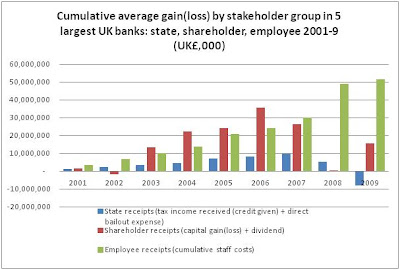


It would be difficult to credit those bankers at the heart of the leveraged, CDO boom ‘talented’ by these graphs, even if they do have an impressive record of educational attainment. In the same way that I would struggle to justify the same term myself if, despite any apparent intelligence and skill, I chose only to teach my students through the medium of mime and blew my departmental budget on powerful hallucinogens which led me to perform demented shamanic rituals on the ashes of my unmarked exam scripts. Talent must be recognised in a particular context, and if the results disappoint then you have to raise serious question about whether those skills are appropriate for that industry, whether high pay is merited, and whether we should be thinking of these people as ‘talent’ at all.

If talent should be judged by performance, and performance is disappointing, how do we explain the endurance of high pay norms then? It may simply reflect two key industry features: i) the revenue earning capacity (NB not profitability) of an industry or field and ii) the number of other charges and claims on that revenue stream. The best paid UK academic will always command a lower price than the best paid UK banker, not because the banker is better in some market for abstract talent, but because a university has an externally imposed revenue ceiling (student quotas, the resources available from funding bodies etc) and a range of administrative, teaching and research costs which mean claims on revenues are distributed amongst the many rather than concentrated amongst the few. Similarly, a graduate with an engineering or physics PhD will be differently remunerated depending on the industry in which he or she chooses to work. Those skills may add equal value in manufacturing or finance, but they will be more generously remunerated in finance because there are a relatively smaller set of claims on that quantum of revenue. The central claim of our 2006 book still stands: high pay is a function of position, not necessarily talent. The real reason elite bankers are paid so much is because they are a small group of interconnected individuals close to a big till.

This ‘big till’ and its attendant high pay norms are a dead weight loss. A dead-weight loss refers to a situation where an implied subsidy or some other distortion leads to an allocative inefficiency. It is usually used by neo-classical economists to describe the distorting effects of taxation, minimum wages etc on a free market. It has even been used by bah-humbug-ers to describe the net losses of gift-giving at Christmas. But here it could be used to describe the effects of a bailout guarantee on the unit value of elite labour. Bank bailouts have had two effects. First they have kept banks on life support and allowed the continued payment of high fees to elite workers, when by rights banks should be cutting costs and writing down debt. Second, with QE, central banks have reduced the costs of capital to banks, allowing them to ramp spreads on their outstanding and future loans – thus providing funds to both recapitalise and maintain pay norms, while passing on costs to their customers (as well as taxpayers and the public sector). This would not happen in any other distressed business, where the workforce would immediately bear the brunt of adjustment.

The big till is underwritten by government and central banks. But what are the social returns? The social dividend is limited by problems of insider claims and opportunity costs. On the former, for example, the generally accepted view of the mutual fund industry is that actively managed funds pay more for their stock pickers than those passive funds who simply buy the index, but that active funds underperform passive funds (eg Gruber 1996). Further studies suggest that net returns to investors are negatively correlated with a fund’s expense levels, which are generally higher in actively managed funds (Carhart 1997). In purely economic terms, this means that talent is overpaid on a marginal cost basis: the skill of active stock pickers may allow the fund to generate superior gross returns, but they incur higher costs from transactions, information and pay, so that net returns to investors are lower. Put in the language of ‘claims’, this is the same as saying that any benefits which might accrue from more accurate stock picking are captured almost entirely by insider talent working within actively managed funds. The same may also be true of activities like high-frequency trading which involve eye-watering sums spent on algorithm-builders, code-writers and telecoms infrastructure which improve latency by milliseconds and give traders manning the war machines of finance fleeting advantages. Returns on individual trades may be marginally higher, but those gains are largely claimed by insiders within the bank. Outcomes for markets are as yet unclear because it is open to all kinds of socially useless wargaming, while returns to investors appear modest and may disappear quickly. And, as Knight Capital’s investors can attest, it may leave your capital exposed to unforeseen software malfunctions and other unanticipated interactions in complex systems – the likes of which Charles Perrow has discussed.

If the higher returns that accrue from modest or superior performance are captured by a small number of insiders, then we need also to think about opportunity costs. That is – if those skills were applied to another area of the economy, would they improve the national economy relatively? If, rather than spending their time writing code for high frequency trading, the same skilled engineers and mathematicians developed new software for high tech manufacturing or green technologies or some other high skill, technology intensive industry, would they produce more jobs, more spin-off activities, more economic multipliers etc? I have no data or study to answer this question (and it is a complex one because HFT clearly creates its own demand for high-tech telecommunications investment), but my hunch is that on balance, they may well do. Skilled workers would undoubtedly be paid less in other non-finance industries, even if their net economic contribution were greater. Is high pay in finance therefore more a market distortion rather than a sign of an efficient market for talent?

It seems that the ‘market for talent’ metaphor is inappropriate when explaining high pay in banking. Activity performance by any measure has been poor, which suggests that whilst these individuals clearly have skills, they cannot be considered ‘talent’ in many instances. Similarly high pay is only possible because the industry is heavily subsidised and operates in a permissive, lightly regulated environment. Their talent is not ‘bid up’ due to its scarcity nor its transformative power. Even at the peak of the boom surveys like that conducted by Deloitte found that only very small numbers of CFOs within financial services claimed there was an ‘inadequate’ supply of talent (defined as “high potential individuals likely to excel in finance”). With such a thing in mind, perhaps the role of the banking institution is not to put a ceiling on elite bankers pay, but rather to put an implicit floor under it by sanctioning certain high risk, high volume, low return activities and creating positions which allow a select few insiders to value skim for considerable personal gain?

Stanley

Wednesday, 25 July 2012

HSBC: Loose Control


The revelations about HSBC’s alleged indiscretions are sobering. What has emerged from the Permanent Subcommittee On Investigations to date is a tale of systematic and deliberate avoidance of anti money laundering (AML) programmes in the US. It is not an edifying read.

The central institution in this story is HSBC’s largest US affiliate: HSBC Bank USA or ‘HBUS’. HBUS is key because it provides HSBC’s overseas clients with access to dollar markets and the US financial system, which is important because the dollar’s role as leading trade currency makes it a prime target for launderers.

Perhaps most staggering is the finding that between 2007-2008, HSBC’s Mexican affiliate, HBMX, shipped $7 billion in physical U.S. dollars to HBUS, more than any other Mexican bank, even one twice HBMX’s size. According to the Chair’s report:

“HBMX operates in a high risk country battling drug cartels; it has had high-risk clients such as casas de cambios; and it has offered high risk products such as U.S. dollar accounts in the Cayman Islands, a jurisdiction known for secrecy and money laundering. HBMX also has a long history of severe AML deficiencies. Add all that up and the U.S. bank should have treated HBMX, the Mexican affiliate, as a high risk account for AML purposes. But it didn’t. Instead, HBUS treated HBMX as such a low risk client bank that it didn’t even monitor their account activity for suspicious transactions. In addition, for three years from mid-2006 to mid-2009, HBUS conducted no monitoring of a banknotes account used by HBMX to physically deposit billions of U.S. dollars from clients, even though large cash transactions are inherently risky and Mexican drug cartels launder U.S. dollars from illegal drug sales. Because our tough AML laws in the United States have made it hard for drug cartels to find a U.S. bank willing to accept huge unexplained deposits of cash, they now smuggle U.S. dollars across the border into Mexico and look for a Mexican bank or casa de cambio willing to take the cash. Some of those casas de cambios had accounts at HBMX. HBMX, in turn, took all the physical dollars it got and transported them by armored car or aircraft back across the border to HBUS for deposit into its U.S. banknotes account, completing the laundering cycle”.

This situation occurred because of the particular way HSBC is run. The report makes it clear that HSBC Group HQ in London instructed its affiliates to assume that every other HSBC affiliate met the group’s AML standards and so should be provided with correspondent banking services. HBUS merely followed this instruction, ignoring more stringent US law which requires due diligence reviews before any US account can be opened for a foreign bank.

In addition to the cross border movement of physical notes, it was also found that HSBC affiliates in Europe and the Middle East circumvented filters set up by the US Treasury Department’s Office of Foreign Assets Control (OFAC) to prevent the funding of terrorist organisations: references to Iran in $19bn worth of US dollar transactions between Iranian entities and HBUS or other US affiliates were stripped out of or omitted from paperwork in 85% of cases, in full knowledge of HSBC’s Chief Compliance Officer and other senior executives in London. There were similar allegations of negligence and cover-ups made regarding HSBC’s ties with the suspect Al Rajhi Bank; clearing travellers cheques for suspicious Russian used car business via a Japanese bank; and offering accounts to ‘bearer share’ corporations, which due to their anonymity are prime vehicles for money laundering and other illicit activity.

It is difficult to dignify such actions with the descriptor ‘neglect’. ‘Neglect’ suggests fault through casual disregard, carelessness or indifference. This kind of behaviour is not an accident; it is written into the DNA of banking in its current form. It is a culture borne of particular structures.

So what structures nurture this kind of behaviour? Two interesting blog posts are illuminating on this issue. The first, an interesting post by an ex-investment banker, Honestly Banking, outlines the problems of what he/she terms ‘loose control’ at HSBC HQ in London. HSBC encourage a quasi-decentralised system whereby relatively autonomous and highly paid 'International Managers' (IMs) are posted to the various HSBC affiliates in senior roles. According to Honestly Banking, loose control creates local mandarins: these IMs make critical decisions in those affiliates and have the right to accept or ignore the recommendations of the local compliance officers. It is unlikely that these IMs run their organisations autocratically, it is likely that decentralisation is replicated at the affiliate level. That is a very effective way of building an organisation that maximises returns from different regions, but it may also encourage accommodation and entanglement with all kinds of risky and unpalatable local operations.

The FT puts this outcome more directly: it is one where “the bank’s business interests trump its compliance obligations”. But that is to confuse the interests of the institution with those who stand to gain individually from this activity. We need to ask a more troubling question: was it really in the long term interests of the institution to behave like this? A second blog post by London Banker highlights this broader tension and the problem of decentralised management. Using the metaphor of a wooden ship, he/she describes a situation where the crew, oblivious to the history and craft of the vessel, are tasked with turning a profit individually, or face being turned ashore. The crew respond by pulling nails from the ship and selling them at each port, at each stage telling themselves that the Admiralty do not understand ships and had specified too many nails in the first place. This sets in train a disastrous set of consequences:

“They self-certify to their warrant officer, who self-certifies to the midshipman, who self-certifies to the lieutenant, who self-certifies to the captain, who self-certifies to the admiral, who self-certifies to the Sea Lords that every nail is where it should be and the supply of surplus nails remains adequate to meet unexpected reverses. And they turn a profit, so everyone is happy and the crew are given bonuses.”

London Banker’s post is concerned with residential mortgage backed securities. But the point applies. Loose control produces both the returns and the information that suites those who have most to gain; but loose control also gradually erodes the hull of the institution. And once the water begins to seep through the timber, all too often it is an emasculated compliance officer that is sacrificed; a most convenient firewall between the authorities and the mandarins in the absence of a paper trail.

Decentralised structures extend the option of informal direction to those in the upper ranks of an organisation and put a lot of people with much responsibility and little power between senior bankers and the regulators. Fining the institution does not begin to address this problem of how elite individuals navigate organisational structures to secure their position and means.

Stanley.

Monday, 9 July 2012

On Banking 'Culture'


Within the press and blogosphere much has been made of Bob Diamond’s note which implies senior officials at the Bank of England and in Whitehall gave Barclays implicit consent to under-report their LIBOR submissions. Such an event, if proven, would be devastating to popular trust in our political and regulatory establishment. For decades our elected leaders granted finance unprecedented privileges and freedom to maraud. The outcome of that freedom was a growing sense of invulnerability that still pervades the trading rooms of major banks today. So it is important, with the mute sense of collusion between regulators and regulated still lingering, to understand these internal cultures and behaviours within the structures that nurtured them.

Last Wednesday’s timid Treasury Select Committee meeting with Bob Diamond was a typical affair, with lots of self-righteous indignation but few probing questions which got into any level of analytical detail about the structural pressures and context of moral laxity. The refrain of the committee, and most likely any Parliamentary Inquiry that may follow, is that banks have a ‘cultural’ problem, and that this needs to change. Like giddy, overexcited children who knock things over at parties, it is assumed bankers can be taught to calm down and behave simply by giving them a stern talking and getting them to admit fault; only then can they be pushed back safely into the melee. ‘Bankers have got carried away’ we are told ‘and so need to take a long, hard look at themselves’.

Cultures set the boundaries of what is and is not permissible. Those rules are not necessarily spoken, they are rooted in behaviour and patterns of reward. When a CEO says ‘we want no more of that sort of thing’ and then increases derivatives trader bonuses, it is the reward rather than the words which reproduce that culture. These are the structures of culture. True, it is important to remember there are different ‘tribes’ with different cultures within banks (there is good journalistic and academic work on this), but it is also true that banks are hierarchies which impose a broader and more potent disciplinary logic: to maximise income for the senior traders. Donald MacKenzie in his most recent revisionist work, refers to this as the principle of ‘maximising Day One P&L’ (for the elite workforce), which often engulfs these silo cultures.

This ‘engulfing’ is what we really saw in this LIBOR fixing scandal: the normalising force of a culture which puts individual bonuses (not institutional profits) at its centre. What is perhaps most startling about the findings of the FSA, is not just the cavalier and open way with which corrupt practices were conducted, but the finding outlined in paragraph 8 of the proceedings which states:

 “Barclays acted inappropriately and breached Principle 5 on numerous occasions between January 2005 and July 2008 by making US dollar LIBOR and EURIBOR submissions which took into account requests made by its interest rate derivatives traders (“Derivatives Traders”). At times these included requests made on behalf of derivatives traders at other banks. The Derivatives Traders were motivated by profit and sought to benefit Barclays’ trading positions.” (my emphasis)

That employees from Barclays were willing to manipulate their own institution’s reported borrowing rates, (with uncertain effects for their employers), to benefit an individual at a competitor company says something profound about banking culture and the structures which support it. It tells us that the boundaries within and between institutions are fluid and that banking culture promotes, perhaps even exalts, the maximisation of personal gain, even if that means building and maintaining interpersonal networks across institutions.

So what is the purpose the institution under such circumstances? Classically in the ‘theory of the firm’ literature, firm boundaries are rigid: they exist to minimise transaction costs (the Coasian perspective), or to manage agency problems (the Jensen and Meckling perspective) or to protect and coordinate certain skills and competences (the Teece et al perspective). All of these theories presume that the firm ‘contains’ activity and in doing so performs some functional purpose for the broader economic good. None of them adequately explain banks. Banks represent something different: an institution captured by its elite workforce, where the purpose of the firm is to act as both shield and sword for its captors. The institution provides cover for the manipulation of prices and markets, for the proliferation of asymmetric information from which private gains are made. The current banking firm allows privacy and insiderism to flourish and incentivises strategies of position, disguise and deception. The outcome is akin to what Akerlof and Romer (1994) described as ‘looting’: maximising individual rewards at the expense of the institution when accounting is poor, regulation is lax and there are few penalties for abuse. The individuals take from the trading profits and the institution is left with the liability.

Psychologically, this is a difficult thing to grasp for the many politicians and regulators who for most of the 1990s and 2000s were absorbed by discussions about financial innovations that improved capital allocation and market efficiency and new whizzbang models that distributed risk away from the financial core, which all justified the need for light touch regulation. In doing so they forgot the crucial point that banks are run by people, and that markets involve a series of intermediated formal and informal agreements between individuals. The problem with banking is that the interests of the individual and of the institution are not necessarily aligned. Modern banking is particularly prone to looting, most obviously because the looting can only go on as long as the institution remains solvent, which is a long time when there is a State bailout guarantee. But more elaborately looting is possible because the presence or absence of profit on a particular trade or at the firm aggregate relies on the quality of the numerical inputs and valuation models used when assigning a price to often complex derivative assets on the balance sheet. Banks are conversion centres: they turn assets into income streams and income streams into bonuses. When derivatives traders ask someone on the cash desk to fix LIBOR, that affects the value of an asset which flatters the return on that trade. It produces, not profit, but the simulacrum of profit. And that is looting.

Of course Barclays no longer uses LIBOR to price many of its interest rate products. The game moves on. It now uses much more complex calculations to value its assets. On its valuation of collateralised interest rates it uses:

“Overnight Index Swap (OIS) rates…to reflect the impact of cheapest to deliver collateral on discounting curves, where counterparty CSA (Credit Support Annex) agreements specify the right of the counterparty to choose the currency of collateral posted”

And on interest rate derivative cash flows it uses:

“…interest rate yield curves whereby observable market data is used to construct the term structure of forward rates. This is then used to project and discount future cash flows based on the parameters of the trade. Instruments and optionality are valued using a volatility surface constructed from market observable inputs. Exotic interest rates derivatives are valued using industry standard and bespoke models based on observable market parameters which are determined separately for each parameter and underlying instrument. Where unobservable a parameter will be set with reference to an observable proxy. Inflation forward curves and interest rate yield curves are extrapolated beyond observable tenors”.
Barclays Annual Report & Accounts, year ending 2011, p234

Given what we know from the past week in banking, we are entitled to ask ‘what does that mean’? Do these accounting values from which revenues are booked and bonuses paid reflect the underlying reality of their financial position?

When you price assets using inputs of uncertain verity which are run through models of great complexity, it is tempting to assume that such convoluted calculations are designed to avoid writing down the value of assets. This would have an income effect and reduce the pot from which bonuses are paid. Do these accounting numbers present the simulacrum of solvency, which avoids the day of reckoning and allows the continuing payment of high incomes to senior bankers? It is something of a curiosity that just as the economics profession has become more and more concerned with finessing ever more complex models, so the financial sector has become acutely aware of its own sociology: a reflexive understanding of the signalling power of numbers. These are active numbers reported to elicit an effect in the future, rather than passive numbers designed to faithfully depict an image of the present. Thus LIBOR is not the rate at which you access unsecured funds, LIBOR is the signal to investors that everything is under control, or that a trade has been particularly profitable.

For many years here at CRESC we have had a growing sense that the instruments of finance have been put to different use from that originally intended. It is quite another thing to think that the most fundamental institution of the capitalist world, the public limited company, is itself being arbitraged in the interests of its elite workforce. But when a bank becomes a tower of assets built on the quicksand of confidence, the incentives to signal good news through numbers is great. It may well be that the more fundamental crisis going forward is not whether there was collusion between regulators and regulated, but whether – again – there is a collective loss of faith in the quality of the accounting data produced by these institutions.

This takes us back to structures. The culture that arises within banks is the product of particular structures, or rather the absence of structures, at three levels: accounting systems, organisation and activity level.

It is clear that the accounting numbers need to better represent the financial position of these organisations. There is too much leeway granted to these institutions to value their own derivative products – it gives rise to huge conflicts of interest. Much of this problem emanates from the pursuit of Day One P&L, which is largely an accounting phenomenon. As a basic start we should reconsider accounting rule HKAS39 which allows this practice to continue. As we have argued elsewhere, if costs were booked upfront and risks calculated non-normally it would mean most products would book immediate losses and only produce profits later in the product cycle. It would therefore tie in bonus pay to the long term performance of the particular products created. Similarly the structurers of those products would have to contemplate counterparty risks going forward, and thus think reflexively about whether they were passing on ‘too much’ risk to others – rather than current practice which is to maximize volume and pass off risk via a swap and consider it ‘somebody else’s problem’.

At the level of the organisation and activity, it is naïve to assume that banking culture will embrace restraint and responsibility without significant structural reform. That reform must take as its core organisational principle that banks must become public utilities with the duty to serve the wider economy. This is a considerable political challenge, and one that must begin by uncovering the patterns of patronage that fostered ‘light touch’ and nurtured the culture of invincibility in the City. Only then can an honest review take place of what needs to be done. Our recommendations are outlined here, in our Deep Stall Paper.

Stanley